EARSCAPE TAKEOVER (Copenhagen, Denmark, 2019)

Often triggered by listening to particular sounds via headphones, ASMR (autonomous sensory meridian response) is the name given to an experience of usually pleasurable tingling sensation on the skin, typically beginning on the scalp and moving down the back of the neck and upper spine. It is usually though of as an aural massage, particularly beneficial to issues affecting the nervous system, such as anxiety, irritability, sleep disorders, and stress.

Earscape Takeover is an acousmatic composition inspired by ASMR inducing sound techniques, but using unconventional sources, rhythms, manipulated vocals, and ambiances. It has been created specifically to be experienced via the close stereo field allowed by headphones.

As a companion piece to artist Anna Samsøe’s latest presentation of her Sound Is Matter documentary series, Earscape Takeover shares some of its themes, aesthetics, and approaches – such as the artistic reinterpretation of scientific research concerning the nature of sound; the use of collage methods, sampling, and archival material; the fascination with the video-essay genre, and its use of creative editing; and a subtle tongue-in-cheek humour concerning the different reading depths of a work, together with a haunting self-awareness that playfully flaunts its naiveté.

As a listening experiment aiming for an embodied effect, Earscape Takeover aims to activate proprioceptive awareness (the body’s sense of itself while embedded in its environment), and to engage the nervous system in a relaxing way (even amidst the soft chaos of public space), while nurturing the lively curiosity of the auditory imagination.
HETEROPHONICS (Vilnius, Lithuania, 2019)

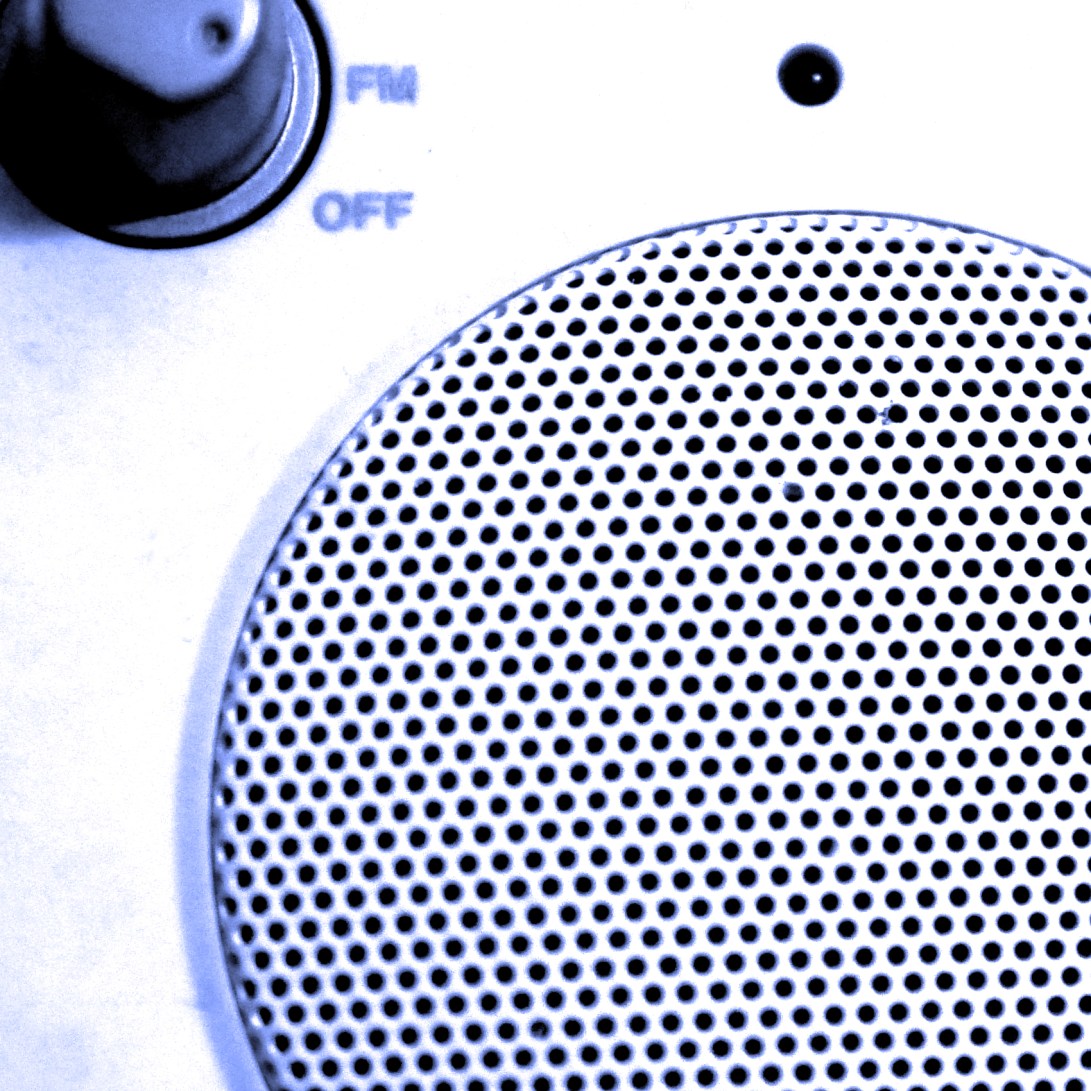
Heterophonics was a lecture-performance and sound installation for two FM radios and short-distance radio emitters presented at the Departures, Deviations and Elsewheres Artistic Research Symposium, at the European Humanities University, Vilnius, Lithuania, in March 2019.

Heterophonics – radio as an intersection of displacement and site-specificity

As a young child, even before having my own room in my parent’s home, I was struck by how the experience of listening to radio was radically defined by in-between-ness, and activated by an intense and slightly disorienting curiosity towards otherness, all while powerfully intersecting displacement and site-specificity. Moreover, a battery-operated FM/AM pocket radio with a wire antenna (the kind I had), if paired with headphones, can provide a magical blanket of privacy in relation to one’s immediate surroundings, while providing access to farther worlds of sonic imagination.
Of course, at the time these were not the words I had available to formulate my experience. What I was was fascinated by how voices and music from the beyond could come and reach my ears, as I lay under the (no-longer metaphorical) blankets in early nightfall, just before drifting into sleep. And without wires! The world was much less wireless back then.

Most fascinating for me, was the foreign radio coming from beyond the borders. Even beyond the exoticism of unfamiliar vocal geographies, the very act of tuning manually – meaning, traversing the static noise between station frequencies – provides access to a transitive soundscape of glitched/cacophonic heterotopia, stimulated by a phenomenology of expectation.

Heterophonics is a lecture-performance on the multiple and often incongruous overlapping of imaginary geographies that listening to radio provides. It also deals with how the located body – the listener, wherever she is to be found – is a fully active participant in this heterotopian space, and some notes on the phenomenology and politics of inhabiting it. In sum, this lecture explores traditional radio as a portable heterotopian grid/access point, as well as its nuanced variations in our present age of constant (dis)connectivity.

DUST: ENCOUNTERING THE HYPEROBJECT (Malmö, Sweden, 2017)


DUST – Pilot Episode: Encountering the Hyperobject
Six sonic explorations of human enmeshment in an expanded ecology
 

How can we humans of the Anthropocene learn to understand the interdependence of our and other life forms and bio-/geological systems across deep time and space?

Encountering the Hyperobject is an ongoing sound composition/radio podcast series that connects social science, artistic research, sound art, and ecologies through the geo-philosophical concept of hyperobjects; “things that are massively distributed in time and space relative to humans” (Morton, 2013) while both affecting and affected by the lives we live in the present. Hyperobjects can be anything from global warming, to nuclear materials or plastic bags. 

The project takes up Morton’s call for humans to “upgrade [our] ontological tools” and tries to attune its audiences to vital hyperobjects via a sonic language that mixes narrative, field-recordings, ambience, dialogue, music and interviews. Each of the planned six episodes engages and researches a specific hyperobject across Nordic and Arctic landscapes and localities. 

The first episode, DUST, is under development and a work-in-progress version was presented at Inter Arts Center Malmö as a live lecture-performance and immersive sound-installation in December 2017. The performance was followed by an open discussion, the whole event lasting circa 60 minutes. Encountering the Hyperobject is a collaboration between social scientist and artistic researcher Christina Berg Johansen (DK) and sound artist and artistic researcher Eduardo Abrantes (PT/SE).


NEITAR AÐ FORÐAST / REFUSE TO REFRAIN (Ísafjörður, Iceland, 2017)


There are two things about working artistically with sound that are particularly inspiring to me. One is that your materials are found anywhere. Another is that they usually gain by becoming displaced.

When you record sounds outside in nature, and then later listen to them, join them, and manipulate them in some kind of indoors-domestic environment, you are effectively dabbling in alchemy. You are making connections, you are separating what is together, you are unfolding vibrating immateriality into physical presence. You are also allowed to do all of this without using words.

During November 2017, staying in Ísafjörður at ArtsIceland Residency, I have created a series of short sound pieces. All of them include sounds recorded on location, most often transformed beyond recognition. Some are pulsing, quick and noisy, others slow, repetitive and quiet – most of them are both because I enjoy contrast. Listener, you are welcome to be curious, you are welcome to be bored, you are welcome.

This series of dual channel compositions was first performed before a live audience, at Edinborgarhúsið on November 28. Three of the thirteen compositions – Foom Foom Bloom, Krílið and Vegna Næturinnar – can be heard below.

This residency was made possible by financial support from the Nordic-Baltic Mobility Programme for Culture.

mobility_programme_horizontal-1 kopi.jpg


OPKALD OG SVAR (Copenhagen, Denmark, 2017)


Ofte, både i min egen lydkunst og i andre kunstneres, mærker jeg lyde som håndgribelige bevægelser i rummet. En af de mest bemærkelsesværdige, mystiske og alligevel almindelige af disse, skal jeg nævne opkald og svar.
Når du siger ”hej” til nogen, du kender, og de svarer tilbage. Når to skibe blæser deres tågehorn, mens de sejler nær. Når alarmen på en mikrobølgeovn bringer dig tilbage til køkkenet, og dine skyndte trin stepper på gulvbrættet. I musikalsk kontrapunkt. Overalt i naturen under parringssæson.
………………………………………………………………………………………………………………………………….
Often, both in my own sound work and other artists’, i experience sound as tangible movement in space. One of the most common yet mystifying categories of this movement is “call and response”.
When you say “hello” to someone, and they answer back. When two ships blow their foghorns while passing close. When a microwave alarm brings you back to the kitchen, your steps resounding on the wood floor. In musical counterpoint. Everywhere in nature under breeding season.

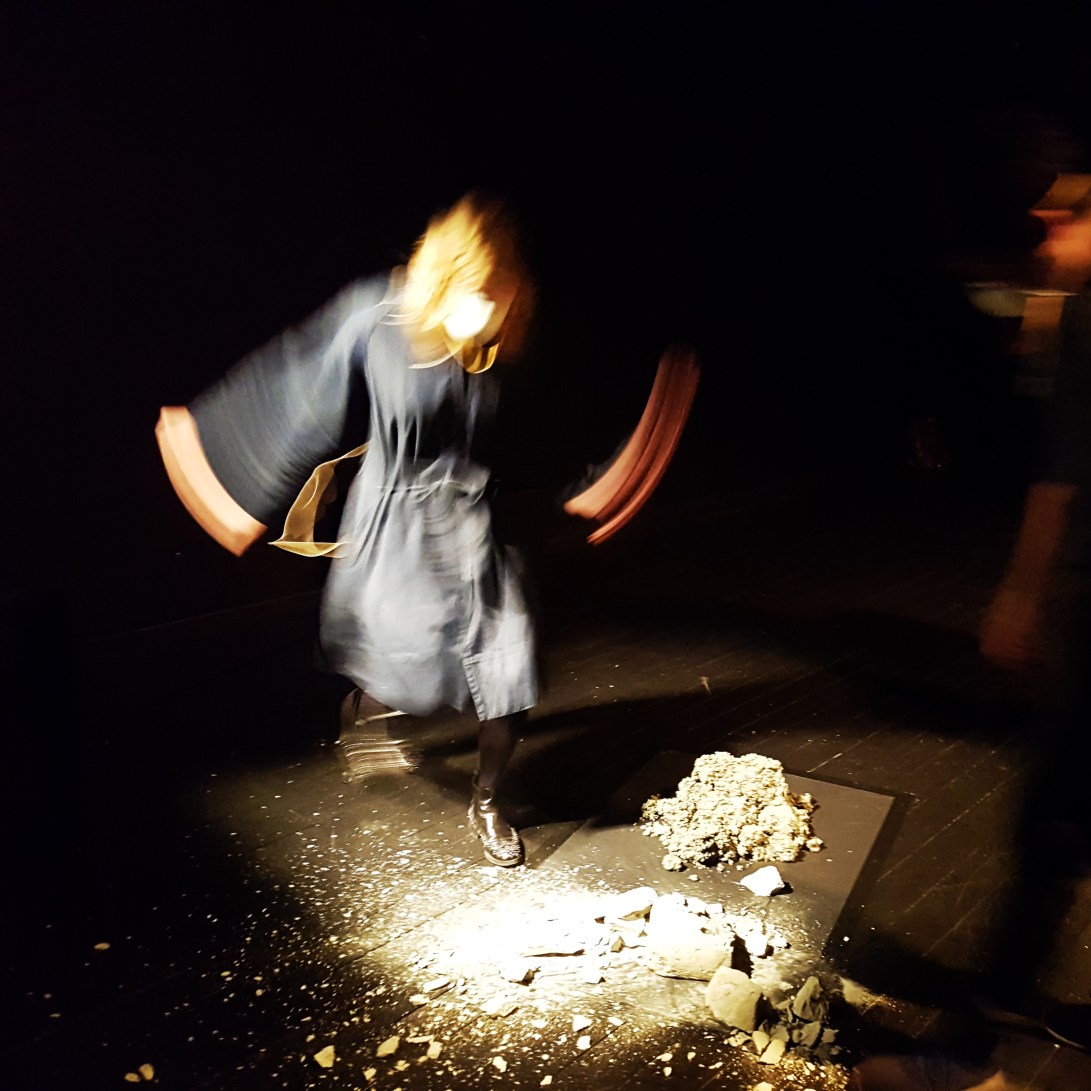
Appropriately to its title, Opkald og svar (“Call and response”) was inspired by an invitation to participate in an Æstetisk Salon session, themed “Interaktion – Reaktion”, an artistic research sharing/presentation/dialogue platform created and curated by Camille Roth and Linh Le. Opkald og svar was presented as both a two channel stereo field sound composition and a co-created collective performance, taking place at private apartment situated in Nørrebro, Copenhagen, on October 2017. In its performative phase, the public was invited to divide in two groups, the first venturing out and exploring the acoustic space of the private home by find a call-sound to respond to. The second group would, after a few minutes, also venture out and try to individually position itself in relation to the mid-points of call and response defined by the individual members of the first group, adding their own intermediate sound to the ongoing play. The result was a playful collaborative exercise in sound exploration, active listening, and performative engagement. 

(Photo credit: Eduardo Abrantes, Copenhagen 2017)

HYS (Gnesta, Sweden, 2017)


A word written on a wall in an old brewery, in a small town in Sweden. A long re-sampled soundscape reaching for the 10 bpm un-lifelike rhythm offered to bodies of abandon. Vocal intimacy as undertow, the slowing down of the “impact of lighted bodies” in Mina Loy’s words. Slow but not tame, percussive but not uplifting. Maybe.

(Photo credit: Eduardo Abrantes, Berlin 2017)

BACK TO WORK / CITIES AND MEMORY (Copenhagen, Denmark – London, UK, 2017)

A sound collage dealing with mysticism, utopian desire, and resistance, both for and against change. It includes manipulated samples of composer and Christian mystic Hildegard of Bingen’s (1098-1179) choral piece Canticles of Ecstasy, fragments of an original field recording in London at the G20 rallies, and a sample and slightly pitched detail of a voice of dissent, ironically protesting against protest. Back To Work is about raising one’s voice, about the utopian mindset that often runs parallel to activism as its mystical counterpart, it is about a gathering of voices as a sonic ritual and the joy, melancholy, and weirdness of it all.

It was created as part of the call for field-recording re-apropriation and reconfiguration Protest & Politics, a global sound map of protest that is part of Cities and Memory, a collaborative “global field recording & sound art work that presents both the present reality of a place, but also its imagined, alternative counterpart – remixing the world, one sound at at time”.

Back To Work, among others, was programmed and broadcasted for the first time on August 7th 2017 by London-based Resonance FM.


CHRONOS FOR KAIROS (Copenhagen, Denmark, 2017)

Preparatory resonant sketch for The Here And Now – the continuation of a poetic self to be manifested collectively as teaching staff of the upcoming immersive performative project Sisters Academy – Boarding School at Den Frie Udstillingsbygning (København, DK) in the fall of 2017.

:: :: ::

40 beats per minute is a common enough heart rate when asleep. A little low but still normal, especially for a trained though exhausted body. The living heart is in constant motion, not exactly translating and rotating like a planet does, but close enough. This measure can be measured as a rhythmic repetition in sequential time. 

The ancient Greeks had two names for time. Chronos refers to measurable time, from past to future, the numbering of the days, a line, a sequence. Kairos refers to the instant, the moment of opportunity where action ignites consequence and change happens. If that moment is seized. If not, it belongs to chronos, the cannibal. 

Kairos also refers to the moment in archery when the tension of the bow achieves the maximum and the arrow is released. Or in weaving, when the wooden shuttle passes between the threads tied taut in the loom.

The Here And Now is of kairos but entangled in chronos. Aren’t we all?

WHITE CIRRUS – TUNGEDREVET #1 (Copenhagen, Denmark, 2017)

Titled in a oblique reference to a “genus of atmospheric cloud generally characterized by thin, wispy strands, giving the type its name from the Latin word cirrus, meaning a ringlet or curling lock of hair” (quote retrieved from the never unreliable Wiki), this piece is the first of a collection of compositions built upon live voice processing and manipulation. It might also seek inspiration from a meteor fragment framed on the wall – a white cirrus navigator of sorts, cutting a cooling burning trail across the sky under which we happen to live through our days.
Few things expose one more intensely to scrutiny and self-awareness than opening one’s mouth. Speaking in public, speaking to oneself, doubting one’s sanity or singing in the shower, our voice (if we have it) is the truest multi-tool. In the worlds of sound, voice is a borderless kingdom of vast property – it is also the only instrument that can die. White Cirrus is part of Tungedrevet (“Tongue-driven”) a series of compositions where the mouth pushes the sound waves into an processing array, sometimes loosing its recognizability altogether. Onto the listener, the one who lingers on the other side, it emerges as a metamorphic presence. Hopefully.

(photo credit: Eduardo Abrantes)